RULE 01
Rule 01: Memory.
What you believe about money, what you've seen, heard, and felt, shapes the way you spend, save, and show up.
Dr. Anthony L. Williams, DBA · @doctalksmoney
Critical Money Theory is a decision-making framework for individuals. It teaches you to see the incentives behind every financial pitch, question conventional money narratives, and make earning, investing, and wealth-building decisions from evidence instead of noise.
Not to be confused with Modern Money Theory (MMT). Critical Money Theory is a decision-making framework for individuals, not a macroeconomic policy school.
Available now on Amazon
The Theory
Wall Street, the media, and the internet all profit when you're confused about money. Confusion sells products. Clarity doesn't. Critical Money Theory is the antidote: a practical lens for seeing the incentives behind every financial pitch, story, and product, so you can question the narrative and decide from evidence.
The Rules
Money is more than math. Three lenses for seeing it clearly.
What you believe about money, what you've seen, heard, and felt, shapes the way you spend, save, and show up.
You don't have to do it all at once. Progress happens one step at a time.
Where you come from, your background, your identity, your community, affects your relationship with wealth.
Available now on Amazon
The Book
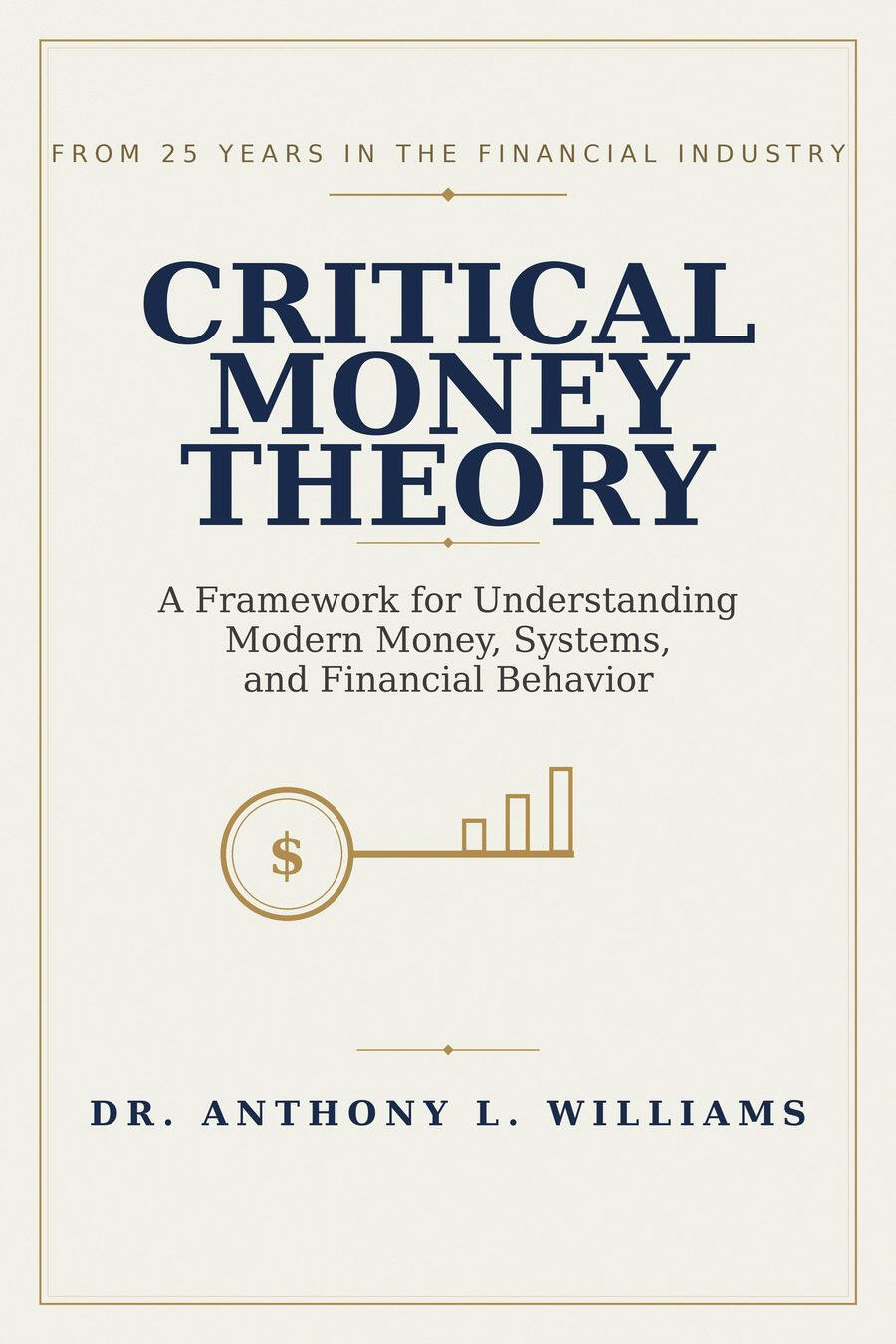
After twenty-five years in the financial industry, Dr. Anthony L. Williams wrote the book he wishes his clients had been given decades ago. Critical Money Theory starts from a simple truth: money is more than math. It's memory, momentum, and culture. Part memoir, part field guide, it combines lived experience with practical financial planning to move you from surviving to thriving. This is for the underdog, the self-starter, the parent figuring it out as they go: anyone who's ever felt the financial world was speaking a different language. It's not about beating the odds. It's about changing them.
What's inside
The Author
Featured & quoted in
Media mentions are informational and do not imply endorsement.
Questions
Critical Money Theory is a decision-making framework for individuals. It teaches you to see the incentives behind every financial pitch, question conventional money narratives, and make earning, investing, and wealth-building decisions from evidence instead of noise. It was developed by Dr. Anthony L. Williams, a financial advisor and Doctor of Business Administration in Finance.
A common rule of thumb is the 25x rule: you need roughly 25 times your annual spending saved. At a 4% withdrawal rate, $1 million supports about $40,000 per year. If you spend $60,000 a year, you'd need closer to $1.5 million, so the real question is what your lifestyle costs, not the round number.
The 4% rule says you can withdraw 4% of your retirement savings in your first year of retirement ($40,000 on a $1 million portfolio), then adjust that amount for inflation each year after. It comes from 1994 research by William Bengen and assumes a roughly 30-year retirement. Many planners now test 3.5–5% depending on time horizon and market conditions.
You can claim as early as 62 at a reduced benefit, wait until full retirement age (67 for anyone born in 1960 or later) for your full benefit, or delay until 70 for the maximum. Each year you wait past full retirement age adds about 8% to your monthly check, but the right choice depends on your health, income needs, and other savings.
Most money advice tells you what to buy. Critical Money Theory teaches you how to think. Instead of stock picks or product recommendations, it gives you three decision filters (follow the incentive, question the narrative, decide from evidence) so you can evaluate any financial advice, including this site's, on your own terms.
Individuals and families making real financial decisions: earners, investors, pre-retirees, and anyone who's ever felt the financial industry was speaking a different language. If you've ever wondered who profits from the advice you're given, this framework is for you.
These answers are educational only and not financial advice. Everyone's situation is different.
Connect
Get Chapter 1 of Critical Money Theory free when you join the list.
Dr. Anthony L. Williams, DBA · Author of Critical Money Theory · Co-Founder, Galene Financial
Follow @doctalksmoney for book updates and new insights.
Back to the top ↑